





Introduction
MatrixCare is a major platform in post-acute care, used across skilled nursing, senior living, home health, and hospice. It is also part of ResMed following ResMed’s acquisition of MatrixCare (announced in 2018).
If you are searching “MatrixCare alternatives,” you are usually in one of these situations:
-
You need better interoperability with hospitals, referral sources, labs, or payers.
-
Your team is frustrated with workflow and usability (too many clicks, slow charting, confusing billing steps).
-
Reporting is painful (you can pull data, but it is hard to turn into operational decisions).
-
You want to modernize the experience for staff, families, or referral partners without ripping out your EHR.
This guide is built to help you pick the right replacement (or companion stack) based on what your team actually does day to day.
TL;DR quick picks
-
Best overall alternative for skilled nursing and long-term care: PointClickCare
-
Best home health plus hospice focused alternative: Axxess
-
Best for broad post-acute plus community care suites: WellSky
-
Best for operational discipline in home health: Homecare Homebase
-
Best for modern cloud home health workflows: AlayaCare
-
Best when respiratory and HME is part of the mix: Brightree
-
Best for large health systems that want everything inside the enterprise EHR: Epic
-
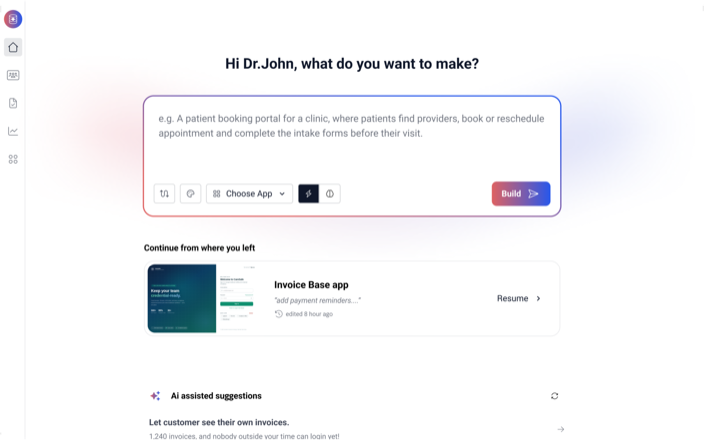
Best “do not replace the EHR, replace the mess around it” option: Build the missing workflows and portals with Tadabase
The key decision most teams miss
Before comparing vendors, decide if you are replacing:
-
Clinical documentation plus orders plus MAR plus billing (true EHR replacement), or
-
Operations around care (intake, referral tracking, authorizations, staffing, portals, audits, QA, document routing, internal dashboards)
A lot of teams do better with a hybrid approach: keep the clinical system stable, then replace everything around it with purpose-built workflows and portals.
That is exactly where Tadabase tends to win: you can build the operational layer your team actually wants without forcing a full EHR migration.
MatrixCare alternatives at a glance
| Alternative | Best for | Why teams pick it |
|---|---|---|
| PointClickCare | SNFs, LTC, post-acute networks | Common SNF standard, broad ecosystem |
| Axxess | Home health, hospice | Strong segment focus |
| WellSky | Post-acute, home health, hospice | Broad suite coverage |
| Homecare Homebase | Home health agencies | Ops discipline and scale |
| AlayaCare | Cloud home health | Modern experience and workflows |
| Brightree | HME/DME influenced orgs | Fits respiratory and HME needs |
| Epic | Health systems | Consolidation into enterprise EHR |
| Tadabase | Ops layer, portals, automation | Build missing workflows around your EHR |
The 10 best MatrixCare alternatives
1) PointClickCare
Choose this if: you are primarily SNF or LTC, you want a widely adopted platform, and you value vendor ecosystem and staffing familiarity.
Why it gets shortlisted: PointClickCare is a common comparison point in SNF tech evaluations. That matters for hiring, cross-facility consistency, and partner expectations.
Watch-outs: if your biggest pain is not the EHR itself but the operational friction around it, you may still need a layer to handle intake, referral tracking, document routing, and external portals.
2) Axxess
Choose this if: you are home health and or hospice and want a platform that is deeply oriented around those workflows.
Why it gets shortlisted: agencies often want something that feels purpose-built for home health and hospice rather than a broad platform trying to cover everything.
Watch-outs: as you grow, the “everything around care” layer (referrals, staffing workflows, authorizations, document packages, QA) often becomes the real bottleneck.
3) WellSky
Choose this if: you want a broad post-acute suite (home health, hospice, community care, coordination) and prefer a suite approach.
Why it gets shortlisted: teams evaluating care coordination and post-acute transitions often see WellSky as a major suite option.
Watch-outs: suites can be powerful, but UX and last-mile workflow fit still matters. Make sure your frontline staff can do their work quickly, not just that the feature exists.
4) Homecare Homebase
Choose this if: home health is your core business and you care about operational control as much as clinical documentation.
Why it gets shortlisted: home health agencies often want tighter operational workflows (visits, scheduling discipline, productivity, compliance) rather than a platform that feels generic.
Watch-outs: confirm reporting flexibility for your specific KPIs. Many tools can generate reports; fewer make it easy to run the business from them.
5) AlayaCare
Choose this if: you want a modern cloud experience for home health and a platform that emphasizes operational workflows.
Why it gets shortlisted: teams looking for a more modern product experience often evaluate AlayaCare in the home health set.
Watch-outs: validate real-world fit by role (clinicians, schedulers, billers, QA). A tool can demo well and still frustrate billing or compliance teams.
6) Brightree
Choose this if: you have respiratory, HME, or DME-adjacent workflows that influence your platform choice.
Why it gets shortlisted: Brightree appears in evaluations where those lines of business matter.
Watch-outs: if your organization is more SNF or traditional home health without that component, this may be less central as a MatrixCare replacement.
7) Epic
Choose this if: you are part of a larger health system or you need everything anchored inside an enterprise EHR.
On G2 comparisons, reviewers have rated Epic as easier to use, set up, and administer versus MatrixCare Home Health and Hospice.
Watch-outs: Epic is a major program, not a lightweight switch. It is usually a strategic health system move, not a simple “better UI” decision.
8) AxisCare (often evaluated for private duty home care)
Choose this if: private duty is central and you want scheduling and caregiver operations to be the core.
Why it gets shortlisted: private duty workflows are different from SNF and skilled home health. Some teams do better with a system designed around that reality.
Watch-outs: if you also need deep clinical documentation and compliance for skilled services, make sure the platform matches that scope.
9) ECP and other senior living focused platforms
Choose this if: assisted living or senior living operations are your primary environment and you want tooling focused on that setting.
Why it gets shortlisted: senior living has different operational workflows than SNF or hospice. Tools that match the setting can reduce friction.
Watch-outs: validate interoperability if you coordinate heavily with hospitals, ACOs, or external providers.
10) Build the missing layer with Tadabase (without replacing your EHR)
Choose this if: your biggest pain is not “clinical charting exists,” but “everything around it is chaos.”
Here are the workflows healthcare teams commonly build on Tadabase as a companion layer:
Referral and intake workflows
-
Referral intake pipeline by facility, payer, service line, urgency
-
Auto-routing to the right coordinator based on rules
-
Status visibility for leadership and partners (without spreadsheets)
Authorizations, eligibility, and payer follow-ups
-
Authorization tracking with SLAs, reminders, and escalation
-
Missing-doc checklists, payer-specific requirements, audit trails
-
One place to see what is blocking admission or start of care
Staffing, scheduling ops, and team handoffs
-
Staffing requests, shift coverage, assignment logic, handoff notes
-
Task queues by role (intake, nursing, therapy, billing, QA)
-
Clear ownership and “what is next” across the team
Compliance, QA, and incident tracking
-
QA audits (chart checks, visit documentation completeness, timeliness)
-
Incident reporting and follow-up workflows
-
Evidence and attachments tied to the record, not trapped in inboxes
Portals for partners and internal teams
-
Secure referral partner portals
-
Facility portals for document upload and status updates
-
Internal dashboards that show bottlenecks and daily workload
Integrations and reporting that actually runs the business
-
Connect data from your EHR, forms, or other systems into one operational view
-
Manager dashboards by location, service line, payer, referrer
-
Exports and scheduled reports without manual spreadsheet work
Why this approach works: replacing an EHR is expensive and disruptive. Building the operational system around it is often faster, safer, and more customizable, especially when every organization has its own process reality.
Why teams pair MatrixCare with Tadabase
If you are not ready to replace MatrixCare, pairing it with an operational layer is often the best path to immediate impact.
MatrixCare can be “the system of record,” while Tadabase becomes:
1) The intake and referral command center
Most teams do not struggle because “the EHR cannot store the data.” They struggle because intake is a chain of emails, spreadsheets, missing docs, and handoffs. Tadabase gives you a clean pipeline with ownership, timestamps, SLAs, and visibility.
2) The system that makes compliance repeatable
Compliance fails in the gaps: missing documents, late signatures, incomplete notes, unclear accountability. Tadabase lets you build checklists, audit workflows, and escalation rules so QA is not dependent on tribal knowledge.
3) The portal layer you control
Many organizations want simple partner portals: upload documents, check referral status, send messages, view what is missing. Tadabase portals are built for that, and you can tailor them per facility, payer, or partner type.
4) The reporting layer that matches how leadership thinks
Leadership rarely wants “a report.” They want an operational picture: where referrals are stuck, why start of care is delayed, who is overloaded, which partners underperform, where denials are rising. Tadabase dashboards can reflect that directly.
5) The “change it next week” layer
EHR changes can be slow and expensive. Operational workflows change constantly. Tadabase is where teams put the workflows that need to evolve fast.
If you want, you can position this section very neutrally in the post: “Replace the EHR” options first, then “keep the EHR, rebuild the ops layer” as a legitimate strategy many teams choose.
How to choose the right MatrixCare alternative (practical checklist)
Use this as your internal scorecard:
Workflow fit by role
-
Clinicians: charting speed, mobile usability, visit workflow
-
Schedulers: schedule building, conflicts, changes, communications
-
Billing: claim workflow, exceptions, reconciliation
-
QA and compliance: audits, logs, policy enforcement
Interoperability and data flow
-
How do referrals come in and get tracked?
-
Can you connect to facilities, hospitals, labs, and payers?
-
Can you export the exact datasets leadership wants?
Reporting that drives action
-
Can managers see daily bottlenecks?
-
Can you build dashboards by location, service line, payer, referral source?
Implementation reality
-
Migration scope and timeline
-
Training burden by role
-
Support quality
-
Total cost including onboarding and ongoing changes
Frequently asked questions
Is MatrixCare owned by ResMed?
Yes. ResMed announced its acquisition of MatrixCare in 2018.
Is Epic a MatrixCare alternative?
For health systems, yes. Epic is commonly compared as an enterprise alternative, and there are reviewer comparisons specifically against MatrixCare Home Health and Hospice.
Do I have to replace my EHR to fix operations?
No. Many teams keep the clinical platform stable and rebuild the workflows and portals around it. That is often the fastest path to better staff experience and better reporting.
Conclusion
If you are replacing MatrixCare outright, shortlist tools based on your care setting first:
-
SNF and LTC teams usually start with PointClickCare.
-
Home health and hospice teams usually evaluate Axxess, WellSky, Homecare Homebase, and AlayaCare.
-
Health systems often default to an enterprise strategy like Epic.
If your biggest pain is the messy layer around the EHR, not the existence of an EHR, you do not need to bet the organization on a full migration to make progress. Many providers keep MatrixCare stable and build the workflows, portals, and dashboards they actually need on top of it with Tadabase.